
For anyone navigating California homeowners insurance 2026, the market has been a difficult one for several years running. Carriers that once competed aggressively for your business stopped writing new policies, premiums climbed sharply, and many homeowners received non-renewal notices with little warning and fewer options. For many, the California FAIR Plan became the only realistic path forward. However, something meaningful is beginning to change, and understanding what is driving that shift could make a real difference at your next renewal.
How We Got Here: Understanding the Crisis
To appreciate what is changing, it helps to understand what broke down in the first place. California’s homeowners insurance market operates under Proposition 103, a voter-approved law that has governed how insurance rates are set in the state since 1988. Under the traditional interpretation of Prop 103, insurers were required to base their rates on historical loss data rather than forward-looking models that project what future claims might cost as climate and risk conditions change. They were also prohibited from including the cost of reinsurance in the rates they charged California policyholders.
For decades, this framework worked reasonably well. Then came the catastrophic wildfire seasons of 2017, 2018, and beyond. The Camp Fire alone destroyed the town of Paradise and generated losses that dwarfed anything California’s historical data had anticipated. Carriers began losing money at a pace their rate structures could not absorb, and because they could not adjust rates fast enough under the existing regulatory framework, many made the rational business decision to stop writing new policies or exit the market entirely.
State Farm, the largest homeowners insurer in California by market share, announced in 2024 that it would non-renew tens of thousands of residential policies. Tokio Marine and Trans Pacific Insurance both exited the state that same year. Then came the January 2026 Los Angeles wildfires, which produced catastrophic losses estimated between $25 billion and $45 billion in insured damages. The FAIR Plan, which had grown to cover more than 450,000 California properties – more than double its 2021 enrollment – faced an existential stress test. The crisis was no longer theoretical.
What’s Changing: The Sustainable Insurance Strategy
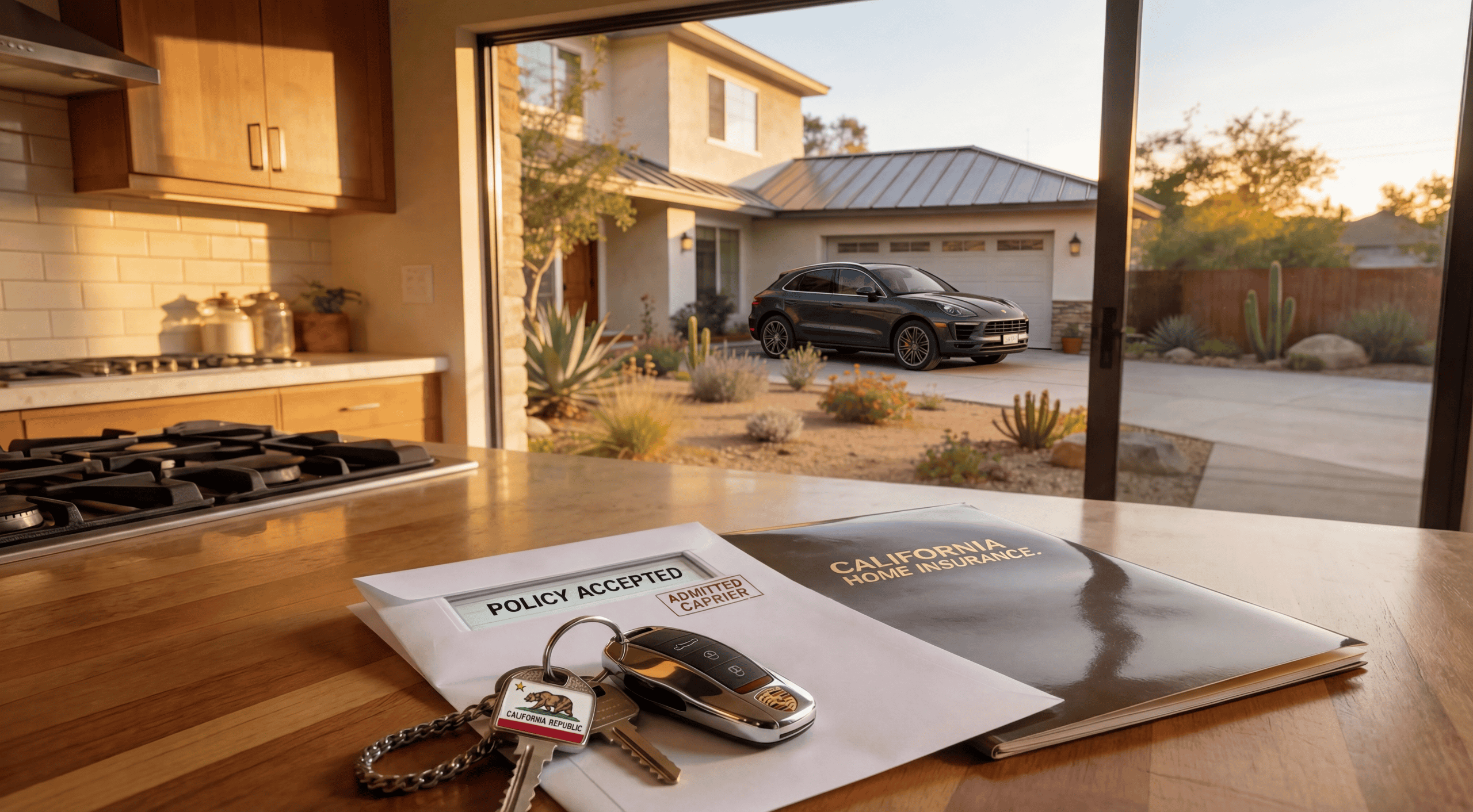
California Insurance Commissioner Ricardo Lara responded to the crisis with a package of regulatory reforms now commonly referred to as the Sustainable Insurance Strategy. The centerpiece is a fundamental shift in how admitted carriers are permitted to set rates in California, and it is the most significant overhaul of the state’s insurance market in more than 30 years.
For the first time, insurers are now allowed to use forward-looking catastrophe models when calculating what to charge California policyholders. This change allows carriers to price coverage based on what the actual risk is today and in the coming years, rather than being locked into historical data from a climate environment that no longer reflects current conditions.
Just as importantly, carriers are now permitted to factor in the cost of reinsurance when setting their rates. In a catastrophe-exposed market like California, reinsurance is a fundamental operating cost, not an optional accounting entry. Allowing carriers to recover that cost through their rates removes one of the primary financial reasons that made California an unworkable market for admitted insurers.
In exchange for these regulatory concessions, the insurance industry agreed to a core obligation: carriers that use catastrophe modeling for rating purposes must increase their writings in high-risk areas, including wildfire-prone communities. The theory is straightforward – if you get to price the risk accurately, you have to be willing to cover it.
What This Means on the Ground: The Bundling Effect
One of the clearest signals of market recovery we are seeing right now involves something that might seem surprisingly straightforward: the bundling of home and auto insurance with the same carrier. For most admitted carriers, writing a homeowners policy on a California property still requires them to feel confident about the overall risk profile of the policyholder.
One of the strongest positive signals a homeowner can send is a clean driving record paired with the decision to bring their auto insurance to the same insurer. From a carrier’s perspective, this makes practical sense. A customer who bundles home and auto is more likely to stay with the company long-term, which improves the overall economics of the relationship. Bundled customers tend to have better loss histories, and for carriers cautiously re-entering a market they retreated from, a bundled account with a preferred driver profile represents a materially lower-risk proposition than a standalone homeowners policy on the same property.
The practical result is that we are seeing admitted carriers approve homeowners placements today that they would have declined eighteen months ago, specifically in situations where the applicant qualifies as a preferred auto risk and is bundling both policies. This is not a universal solution and does not apply to every property or every risk profile. However, it is a real opening that did not exist before, and it is one we are actively exploring for clients whose renewals are coming up.
The FAIR Plan and the Non-Admitted Market: Context That Matters
Understanding why a shift back toward the admitted market is good news requires understanding what the alternatives have looked like. The California FAIR Plan was designed to serve as an insurer of last resort – a safety net for properties that cannot find coverage in the private market. It is not a government program funded by taxpayers; it is a shared risk pool supported by all licensed insurers operating in the state. However, it was never designed to be a primary market, and it has serious limitations that many homeowners discover only after a loss.
The FAIR Plan covers four named perils: fire, lightning, smoke, and internal explosion. It does not cover theft, liability, water damage, or vandalism. Coverage is capped at $3 million per residential structure. Homeowners relying on the FAIR Plan typically need to purchase a separate Difference in Conditions policy to fill the gaps, adding cost and complexity to an already strained situation.
The non-admitted or surplus lines market has played a critical role in filling the gap left by admitted carriers, and it remains an important part of the market we work with regularly. Non-admitted carriers have the flexibility to underwrite properties that standard admitted carriers will not touch, and they are not subject to the same rate filing requirements, which allows them to move quickly.
The trade-off is that non-admitted carriers are not members of the California Insurance Guarantee Association (CIGA), the state safety net that protects policyholders if an admitted carrier becomes insolvent. This is why we evaluate non-admitted carriers carefully, looking at independent ratings from agencies like AM Best as a primary indicator of financial health. A carrier rated A or better by AM Best offers meaningful assurance of claims-paying ability even without the CIGA protection.
[Link to authoritative source on the California FAIR Plan and CIGA protections]
5 Proven Steps for California Homeowners Insurance 2026 Renewals
The market shift we are describing is real, but it is modest and uneven. Not every homeowner will benefit, and the window of opportunity may look different depending on your property’s location, its risk profile, and your personal insurance history. Here is what we encourage you to do as your next renewal approaches.
Know where your current coverage comes from. If you are currently covered by the FAIR Plan or by a non-admitted surplus lines carrier, you may have more options than you realize – particularly if your situation has changed since you last explored the admitted market. It is worth a fresh look, as California homeowners insurance 2026 options have expanded meaningfully for some risk profiles.
Take your driving record seriously as an asset. If you have a clean driving record and you are not currently bundling your home and auto insurance with the same carrier, this may be your single most actionable lever for accessing admitted coverage. A preferred auto profile can meaningfully change what options are available to you.
Start early. Admitted carriers that are cautiously re-entering the market are not doing so with unlimited capacity. The best opportunities tend to go to policyholders who are proactive. If your renewal is three or four months out, now is the right time to start exploring – not two weeks before your current policy expires.
Understand your current policy’s actual coverage. Whether you are on the FAIR Plan, a surplus lines policy, or an admitted carrier, make sure you know what you have. What perils are covered? What is your dwelling coverage limit, and does it reflect current replacement costs? These questions matter most before a loss, not after.
Work with a broker who has real market access. The shift we are describing is not yet visible in online quoting tools or direct-to-consumer channels. It is happening through brokers who have relationships with carriers that are selectively re-engaging the California market. Access matters right now in a way that it simply did not when the market was deep and competitive.
Final Thoughts
We spend a lot of time delivering difficult news to California homeowners – non-renewals, premium increases, and limited options. It is genuinely encouraging to write something different. The market shift we are seeing is modest and is not a return to the broad, competitive market that existed before 2017. The wildfire risk that drove carriers out of California has not diminished, and the regulatory and economic forces that constrained the market have only partially resolved.
Nevertheless, momentum has turned in a direction we have not seen in years, and for homeowners who are paying attention and working with the right people, real opportunities exist right now that were not there twelve months ago. If your homeowners renewal is coming up in the next several months, we would genuinely like to see what your options look like. Contact Falcon West Insurance Brokers today to explore your coverage and find out whether more is available to you than you expect.
Falcon West Insurance Brokers (CA License #4215080) is an independent property and casualty brokerage serving clients across California. We work with both admitted and non-admitted carriers and are committed to providing honest, comprehensive guidance on coverage options. This article is for informational purposes only and does not constitute insurance or legal advice. Coverage terms, limits, and regulatory requirements are subject to change. Please consult with a licensed California insurance professional to discuss your specific circumstances.
For homeowners who have added solar, see our guide to insuring solar panels.
Taking proactive steps to improve your home’s safety and insurability.
Before your next renewal, be prepared with the photos your carrier needs.